Sabine Baring-Gould was born in the parish of St. Sidwell, Exeter in 1834, the eldest son of Edward Baring-Gould and his first wife Sophia. He was named for an uncle, the Arctic explorer Sir Edward Sabine. Edward, an officer with the East India Company, had a disabling carriage accident and decided that if he couldn’t work, he could at least travel. As a result, little Sabine was dragged from one end of Europe to the other, year after year. It gave him an unsettled childhood and spotty schooling. Because the family spent much of his childhood travelling round Europe, most of his education was by private tutors. He only spent about two years in formal schooling, first at King's College School in London and then, for a few months, at Warwick Grammar School. There his time was ended by a bronchial disease of the kind that was to plague him throughout his long life. His father considered his ill-health as a good reason for another European tour.
In 1852 he was admitted to Cambridge University and with considerable effort earned the degree of Bachelor of Arts in 1857, then Master of Arts in 1860 from Clare College. During 1864, he became the curate at Horbury Bridge. He wrote during the week and cleaned out his upstairs apartment for church services on Sundays.
On one stormy day, the river that flowed through the town was flooding when he noticed from his upstairs window a girl being carried downstream. He made it to the river, threw himself in and rescued Grace Taylor, the 16-year-old daughter of a mill hand. In saving her life and becoming involved in her situation, the two fell in love, though he was 14 years her senior. He was from the middle class and her lower social class status would keep her from being the wife of a prominent pastor. His vicar arranged for Grace to live for two years with relatives in York to learn middle class manners. Sabine, meanwhile, relocated to become perpetual curate at Dalton, near Thirsk. He and Grace were married in 1868 at Wakefield. Their marriage lasted until her death 48 years later. The couple had 15 children; all but one lived to adulthood. When he buried his wife in 1916 he had carved on her tombstone "Half my Soul" in Latin.
Baring-Gould became the rector of East Mersea in Essex in 1871 and spent ten years there. In 1880 he inherited the 3,000 acre family estate of Lew Trenchard in Devon, which included the gift of the living (living in the vicarage) of Lew Trenchard parish. When the living became vacant during 1881, he was able to appoint himself to it, becoming parson as well as squire. He did a great deal of work restoring St. Peter’s Church, Lew Trenchard, and (from 1883–1914) thoroughly remodeled his home, Lew Trenchard Manor. The manor has recently been restored and is now open as an elegant hotel. He died in 1924, just shy of his ninetieth birthday and is buried next to his wife, his other half.
The British Museum list more titles by Baring-Gould than by any other writer of the Victorian era. For fifty-two years, he wrote a novel every year. He wrote on religion, mythology, biography, travel, folklore and theology. He published a complete book of hymns and a collection of English folk songs that he tracked and wrote down himself. Some of his novels have recently been reprinted and are gaining in popularity, but it will be two hymns that endear him to the hearts of so many: Onward Christian Soldiers and Now the Day is Over.
In his own words, this is what Baring-Gould had to say about Onward Christian Soldier.
“Whit-Monday is a great day for school festivals in Yorkshire. One Whit-Monday, thirty years ago, it was arranged that our school should join forces with that of a neighboring village. I wanted the children to sing when marching from one village to another, but couldn’t think of anything quite suitable; so I sat up at night, resolved that I would write something myself. Onward, Christian Soldiers was the result. It was written in great haste, and I am afraid some of the rhymes are faulty. Certainly nothing has surprised me more than its popularity. I don’t remember how it got printed first, but I know that very soon it found its way into several collections. I have written a few other hymns since then, but only two or three have become at all well known.” S. B-G 1895
Baring-Gould used the tune St. Alban, a moving and easy but rather lackluster melody when he taught the children this marching song. Six years later, Sir Arthur Sullivan added his tune St. Gertrude to the lyrics, making the song we know today.
Notice the lyrics of this song:
Onward, Christian soldiers, marching as to war,
With the cross of Jesus going on before;
Christ, the royal Master, leads against the foe;
Forward into battle, see His banners go!
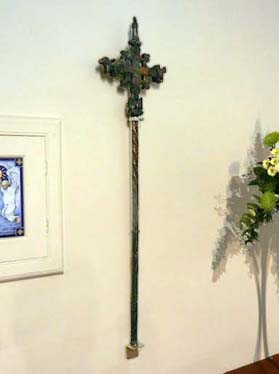
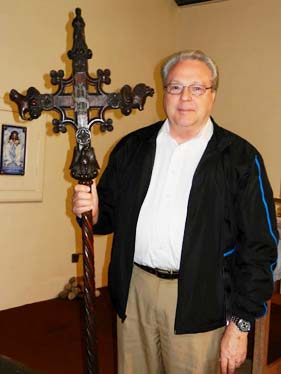
It seems that Sabine Baring-Gould was good at a lot of things, one was woodcarving. When the children went marching, they had a cross to follow, just as the song states. And what else did they carry with them?
|
|
Now the Day is Over was written a year earlier but we have no information about why he write it, other than he was always writing and felt a need.
For other pictures from the Jerry Rushford tour, go to:
http://www.paperlesshymnal.com/tour/
References:
Wikipedia
A Hymn is Born - Bonner / Broadman Press 1959
Hymns & History - McCann / ACU Press 1997
Stories of Hymns We Love - Rudin / John Rudin & Company, Inc. 1941
Then Sings My Soul - Morgan / Thomas Nelson Publishers 2003
A Literary & Hymn Pilgrimage - Dr. Jerry Rushford 2011