Isaac Watts (1674-1748) was born to Enoch and Sarah Watts. Enoch was a deacon in the Above Bar Congregational Church in Southampton, England, known as “Dissenters” or Non-Anglican and later Puritans, which at that time was a treasonous offense. About the time that Isaac arrived prematurely, his father was arrested for his open display of faith against the Anglican Church. It is said that Sarah nursed her newborn while seated on a stone outside the prison during the years of his imprisonment.
Isaac took to books far quicker than most and by the time he was four, his father had taught him Latin, by nine he knew Greek, and by thirteen he knew Hebrew. He learned to rhyme from his mother and would converse extensively while rhyming. At one point his father grew so tired of it that he threatened to flail the young Isaac if he did not stop, to which the younger Watts replied, “O father do some pity take, and I will no more verses make!”
Though he had offers for support from a local banker to attend Oxford, Isaac went on to graduate from the school for Dissenters in Stoke Newington, London, where he excelled.
He returned to Southampton when 19. On a Sunday in 1692, while the cantor read the Psalms and the audience repeated it back in the traditional way, Isaac refused to sing along. This outraged Deacon Watts and called Isaac on the carpet for such behavior. Isaac blurted that there was no music in the Psalms and since they didn’t rhyme, they shouldn’t be sung line by line. What resulted was a challenge if he could do better. The challenge was accepted and what resulted was the following poem taken from his recent study of Revelation 5:
Behold the glories of the Lamb
Amidst His Father’s throne;
Prepare new honors for His name,
And songs before unknown.
The congregation loved the new song and over the course of several years was rewarded with a new song each Sunday. This would be the first of over 600 hymns penned by Watts.
Leaving Southampton, Watts joined the Mark Lane Independent Chapel in London and later became its pastor, a position he retained for the rest of his life. In 1707 he published his Hymns and Spiritual Songs collection. In that collection can be found “When I Survey the Wondrous Cross”, “Heavenly Joy on Earth” better know as “Come, We that Love the Lord”, “We’re Marching to Zion”, and “Godly Sorrow Arising from the Sufferings of Christ” better known today as “Alas! and Did My Savior Bleed.”
Watts’ hymns grew in popularity and caused a tempest between those who called them “Watts’ flights of fancy” and those who considered them as the savior of Sunday worship. The controversy even made its way to the American Presbyterian Church. I suppose you could call this the first of the worship wars.
He was a little man, not over five feet in height, but with a disproportionately large head, with a prominent nose and “tallowy” skin. It may be for this reason as much as any other that he never married and in later life was in ill health. He accepted the invitation of Sir Thomas and Lady Abney for a weeks rest at their estate in 1712 and ended up staying there the rest of his life. While there he wrote “I Sing the Mighty Power of God”, "O God, Our Help in Ages Past”, and “Am I a Soldier of the Cross?”
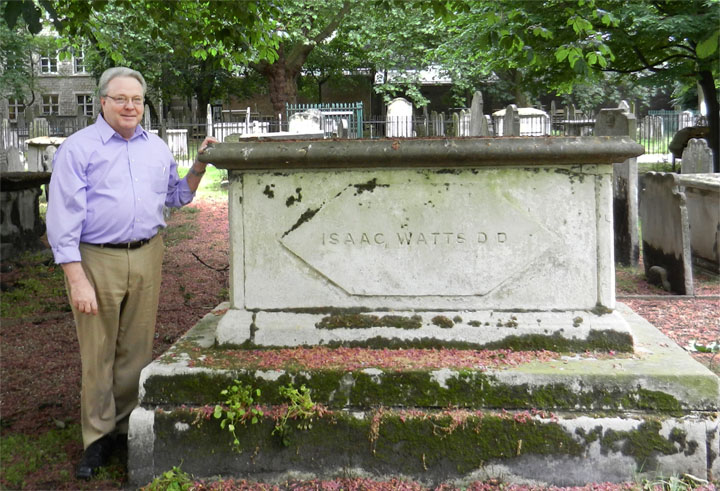
He was buried in Bunhill Fields in London, along with John Bunyan the author of “Pilgrims Progress”, Daniel Defoe the author of “Robinson Crusoe”, and other famous poets and leaders of the time. He is known as the "Father of the English Hymn".
 References:
The Oxford Companion to Music - Scholes / Oxford University Press 1947
A Hymn is Born - Bonner / Broadman Press 1959
Hymns and History - McCann / ACU Press 1997
Then Sings My Soul - Morgan / Thomas Nelson Publishers 2003
A Song if Born - Taylor / Taylor Publishing 2004
Dr. Jerry Rushford - A Literary & Hymn Pilgrimage 2011